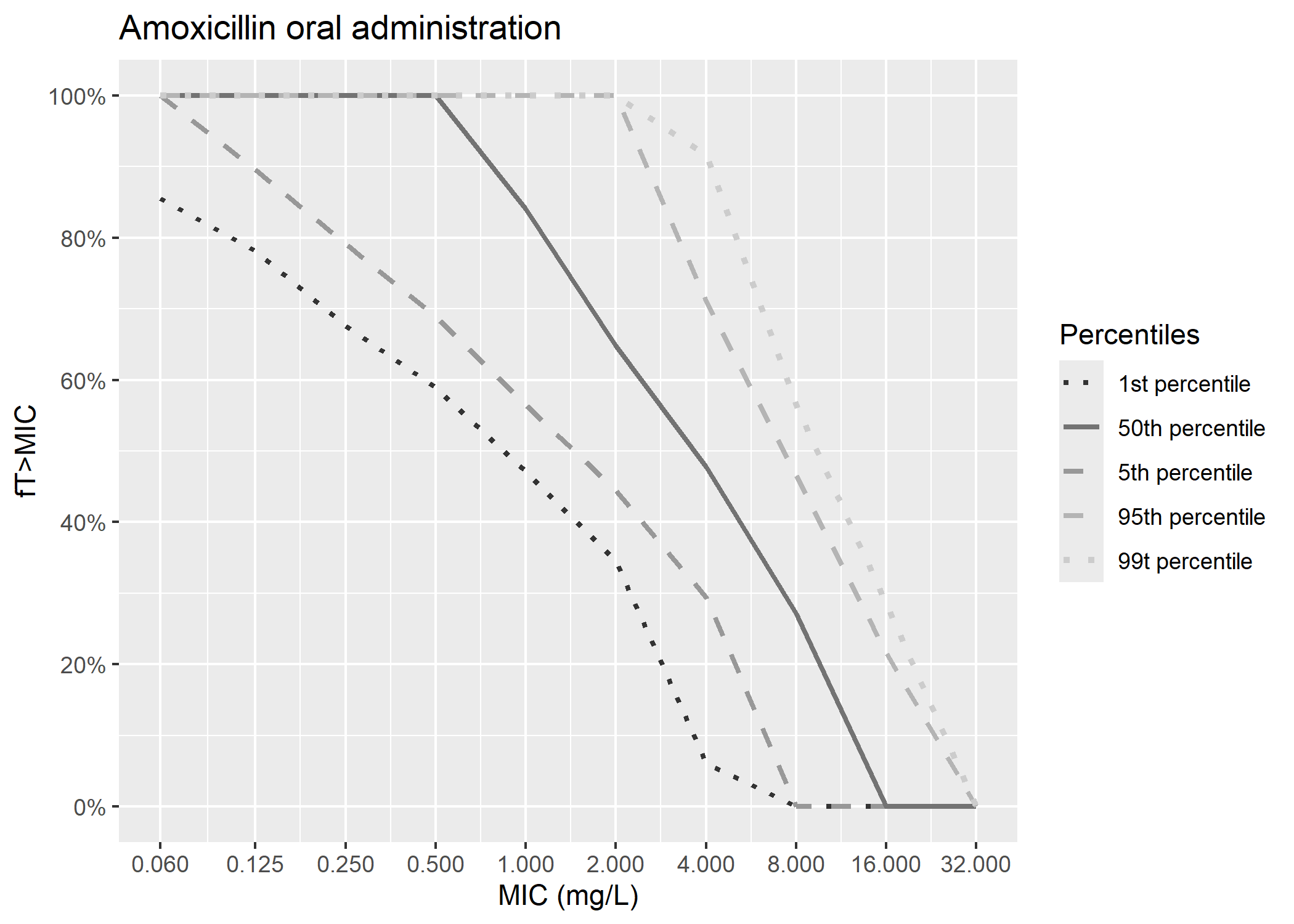
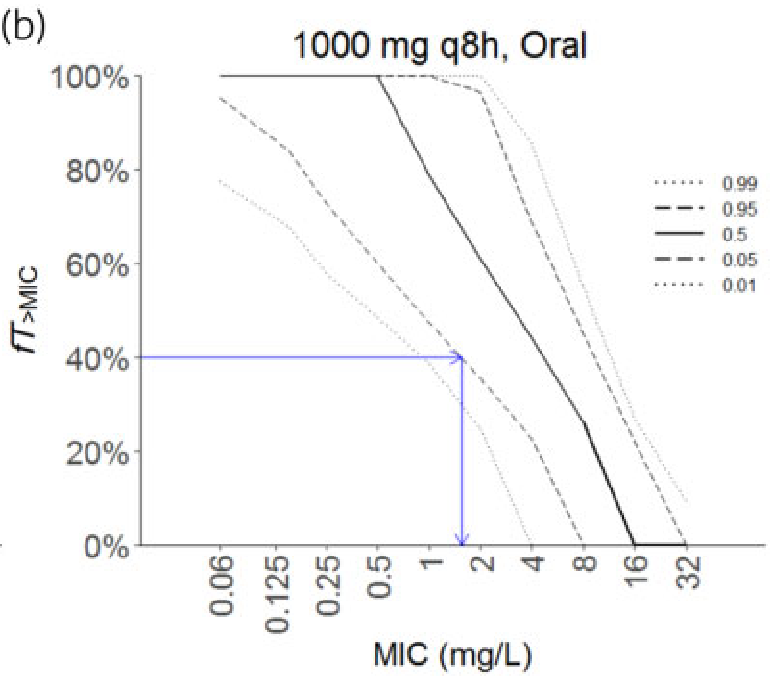
here::i_am("Model_implementation_validation/quarto/valid_amox_mellon_hammas_2020.qmd")# Functions used for simulation-----# export functions contained in the "functions" folderlist_of_function_path =list.files(path = here::here("Model_implementation_validation/R_functions/"),pattern =".*\\.R$",full.names =TRUE ) purrr::walk(.x=list_of_function_path,.f=source)
interindividual variability for all parameters, log-distribution for all parameters except F
weight on absorption rate
27
total
0.8
5.1 Model parameters
Show the code
# when @correlation is used in OMEGA, mrgsolve assume off-diagonal elements to be correlation coefficients# and calculate the covariances# we want to use a single omega matrix, so no correlation matrix will be used# thus instead of the correlation coefficient between eta CL and ETA Q we have to enter their covariance # the following formula is used : # covariance(CL, Q) = correlation coefficient(CL,Q)*(SD(CL)*SD(Q))# SD = standard deviation cov_CL_Q =0.9*(0.27*0.59)# value rounded to two significant numbers : 0.14
Relation between weight and absorption rate constant
log h-1
-3.100
19
10.1093/jac/dkaa373
CLpop
Typical clearance
L/h
14.600
5
10.1093/jac/dkaa374
Vcpop
Typical central volume of distribution
L
9.000
11
10.1093/jac/dkaa375
Qpop
Typical intercompartimental clearance
L/h
4.200
12
10.1093/jac/dkaa376
Vppop
Typical peripheral volume of distribution
L
6.400
8
10.1093/jac/dkaa377
omega_F
Standard deviation of F random effect
unitless
1.000
20
10.1093/jac/dkaa378
omega_Mtt
Standard deviation of Mtt random effect
unitless
0.250
19
10.1093/jac/dkaa379
omega_Ktr
Standard deviation of Ktr random effect
unitless
0.490
17
10.1093/jac/dkaa380
omega_Ka
Standard deviation of Ka random effect
unitless
0.250
40
10.1093/jac/dkaa381
omega_V1
Standard deviation of V1 random effect
unitless
0.500
17
10.1093/jac/dkaa382
omega_CL
Standard deviation of CL random effect
unitless
0.270
16
10.1093/jac/dkaa383
omega_V2
Standard deviation of V2 random effect
unitless
0.300
23
10.1093/jac/dkaa384
omega_Q
Standard deviation of Q random effect
unitless
0.590
15
10.1093/jac/dkaa385
correlation
Correlation between random effects of CL and Q
unitless
0.900
7
10.1093/jac/dkaa386
SD_a
Standard deviation of the additive component for the residual error model
mg/L
0.383
15
10.1093/jac/dkaa387
SD_b
Standard deviation of the proportional component for the residual error model
mg/L
0.131
7
Given both the concentration’s values and the values of standard deviations of the additive and proportional components of the residual error model for the basic model, we choose to divide by 100 the component’s values announced for the final model with covariates.
5.2 Interindividual variability and covariate effects
The only covariate retained by the article’s authors is weight.
According to the article, all model parameters are log-normally distributed, except F wich is logit transformed :
\[
F = log(F_{pop}/(1-F_{pop})) + \eta^F
\] With :
\(EF\) : normal variable with mean 0 and variance \({\omega_{F}}^2\)
6 Validation of the model implementation
To validate the model’s implementation, simulations were compared with the article’s observations of figure 1 and 3.
For the simulations appearing later in the article, “body weight was randomly drawn from a uniform distribution [85–155 kg], which corresponds to the range of weights observed at the inclusion of participating subjects”. To create “patients” for our simulations, weights were sampled from a uniform distribution with that density.
7 Figure 1
Show the code
# generate weights from the uniform distribution : set.seed(100)weights =runif(n =27, min =85, max =155)|>as.data.frame() |> dplyr::rename(BW ="runif(n = 27, min = 85, max = 155)") |> dplyr::mutate(ID =1:27)write.csv(weights, file = here::here("Model_implementation_validation/data/mellon_hammas_2020/patients_weights.csv"), row.names =FALSE)
First, we created 27 “patients” by sampling weights from the uniform distribution described above. We then simulated concentrations for 27 “patients” using typical parameters values and inter individual variability. This was intended as a control.
The weights of the patients included in the study are unknown. Moreover, our simulations were taking inter individual variability in account. As a result, we were not expecting to reproduce the observed concentrations profiles described in figure 1. This was intended as a control of the overall time-concentration profile.
Show the code
# in the article, "An ‘IV + oral obese population PK model’ was then adjusted to the whole set # of amoxicillin concentration data obtained after both IV and oral administration."# Our model has to be used for oral and IV simulations. # simulations for 27 patients, oral administration : # arguments : # dosing regimendose_oral = readr::read_csv(file = here::here("Model_implementation_validation/data/mellon_hammas_2020/dosing_regimen.csv"), show_col_types = F) |> dplyr::filter(regimen_id =="oral") |> mrgsolve::as.ev()dose_oralsim_dur_8h =8model = mrgsolve::mread(model = here::here("Model_implementation_validation/mrgsolve/amox_Mellon.cpp"),show_col_types = F)patients =read.csv(file = here::here("Model_implementation_validation/data/mellon_hammas_2020/patients_weights.csv")) patientssim_step =1/6path_to_param = here::here("Model_implementation_validation/data/mellon_hammas_2020/model_parameters.csv")default =list(MIC =1, BW =1)# simulation : sim_oral_8h_27_patients =simulate_mrgsolve(dosing_regimen = dose_oral,sim_dur = sim_dur_8h,model = model,patients = patients,sim_step = sim_step,param_file = path_to_param,cov_default = default,omega_mat =NULL)sim_oral_8h_27_patients# simulations for 27 patients, one infusion of 60 minutes# dosing in the second compartment (CENTRAL)# dosedose_iv = readr::read_csv(file = here::here("Model_implementation_validation/data/mellon_hammas_2020/dosing_regimen.csv"), show_col_types = F) |> dplyr::filter(regimen_id=="IV") |> mrgsolve::as.ev()dose_iv# simulationsim_iv_8h_27_patients =simulate_mrgsolve(dosing_regimen = dose_iv,sim_dur = sim_dur_8h,model = model,patients = patients,sim_step = sim_step,param_file = path_to_param,cov_default = default,omega_mat =NULL)sim_iv_8h_27_patients
Show the code
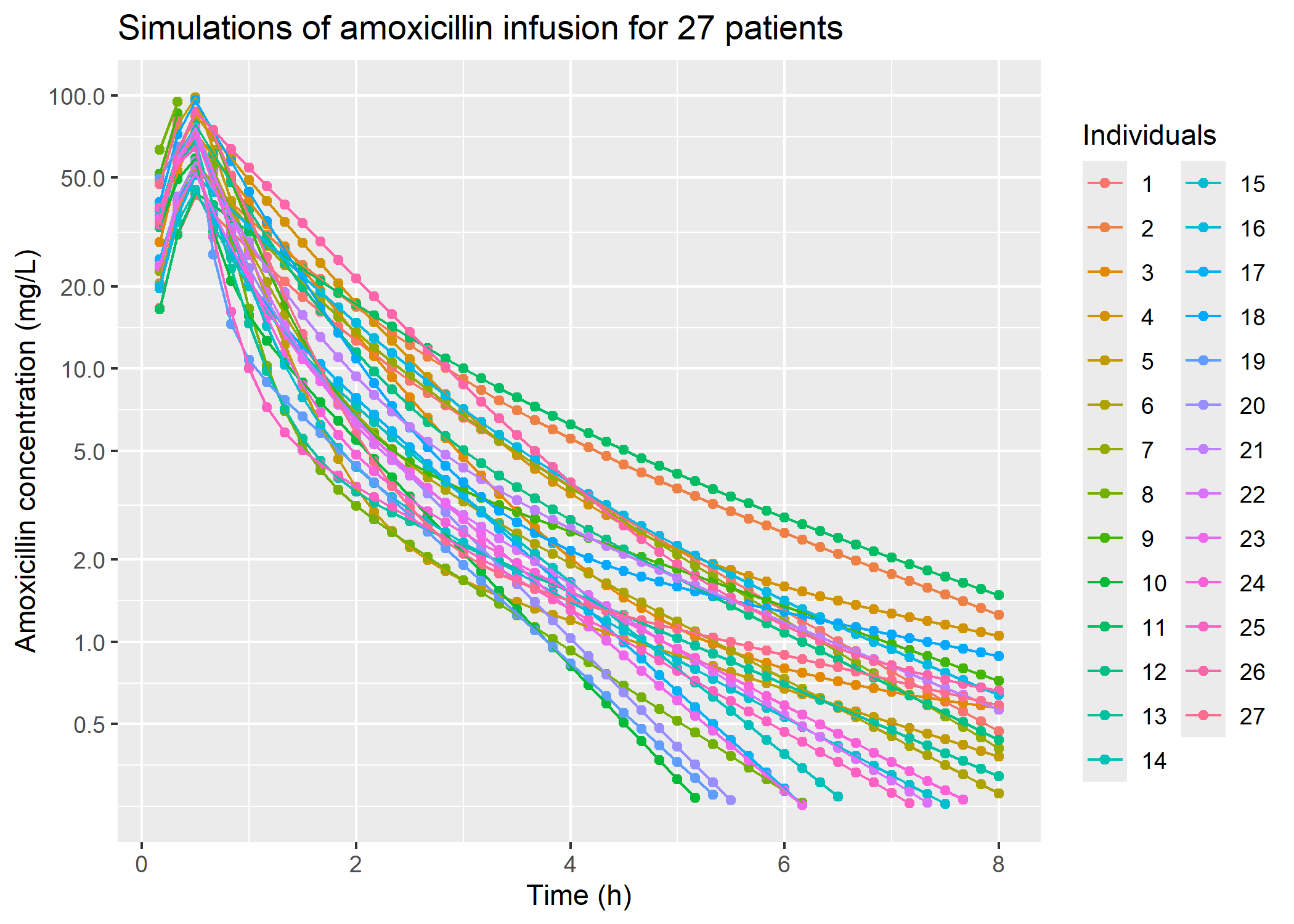
# plot IV administrationplot_iv_8h_27_patients = sim_iv_8h_27_patients |> dplyr::filter(time !=0) |> ggplot2::ggplot(mapping = ggplot2::aes(x = time, y = IPRED, color =as.factor(ID))) + ggplot2::geom_point() + ggplot2::geom_line() + ggplot2::scale_y_continuous(transform ="log2",breaks =c(0.5, 1, 2, 5, 10, 20, 50, 100),limits =c(0.25, 100)) + ggplot2::labs(title ="Simulations of amoxicillin infusion for 27 patients",color ="Individuals",y ="Amoxicillin concentration (mg/L)",x ="Time (h)")plot_iv_8h_27_patients
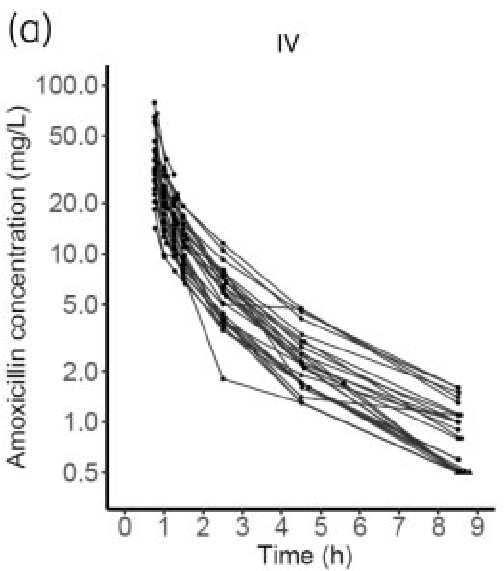
Article’s figure 1a, IV administration, compared with simulations
For amoxicillin IV administration, Cmax and the most of the time-concentration profiles look similar. However, for a lot of the simulated “patients” concentrations decrease quicker or to lower values than the real patient’s of the article.
Show the code
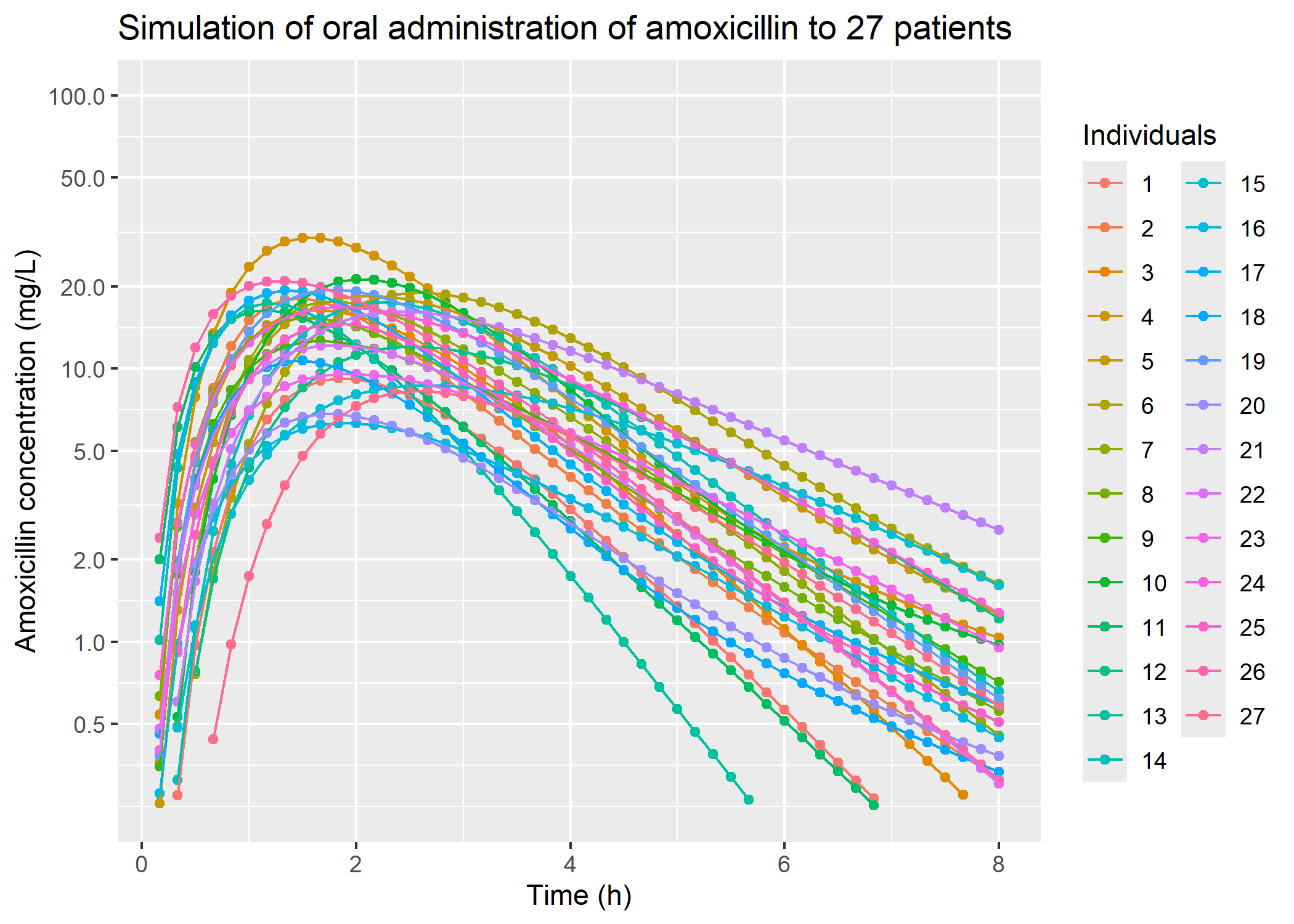
# plot oral administration: plot_oral_8h_27_patients = sim_oral_8h_27_patients |> dplyr::filter(time !=0) |> ggplot2::ggplot(mapping = ggplot2::aes(x = time, y = IPRED, color =as.factor(ID))) + ggplot2::geom_point() + ggplot2::geom_line() + ggplot2::scale_y_continuous(transform ="log2",breaks =c(0.5, 1, 2, 5, 10, 20, 50, 100),limits =c(0.25, 100)) + ggplot2::labs(title ="Simulation of oral administration of amoxicillin to 27 patients",color ="Individuals",y ="Amoxicillin concentration (mg/L)",x ="Time (h)")plot_oral_8h_27_patients
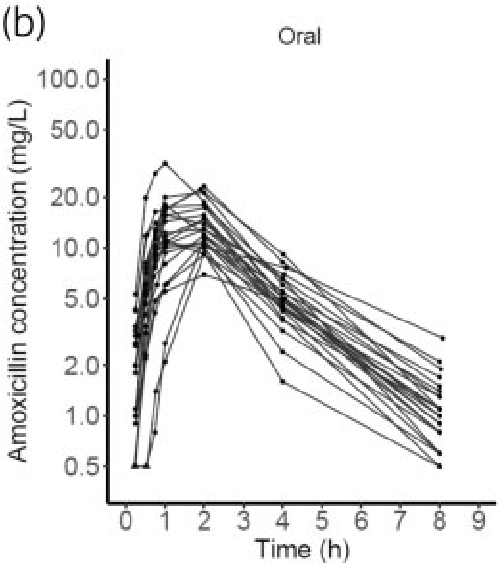
Article’s figure 1b, oral administration, compared with simulations
For amoxicillin oral administration, Tmax and Cmax of our simulations and the original article looks the same and overall profile seems similar. However, like for IV administration, some simulated patients’ concentrations decrease more and quicker than the real patients’.
Those differences may be caused by interindividual variability and differences between real and simulate dpatients’ weights.
8 Figure 3
In the article, 500 simulations were used in order to generate visual predictive check (VPC) for the final model. We simulated 500 “patients” with different weights to reproduce figure 3.
Show the code
# generate weights from the uniform distribution : set.seed(100)weights_500 =runif(n =500, min =85, max =155)|>as.data.frame() |> dplyr::rename(BW ="runif(n = 500, min = 85, max = 155)") |> dplyr::mutate(ID =1:500)write.csv(weights_500, file = here::here("Model_implementation_validation/data/mellon_hammas_2020/patients_weights_500.csv"), row.names =FALSE)
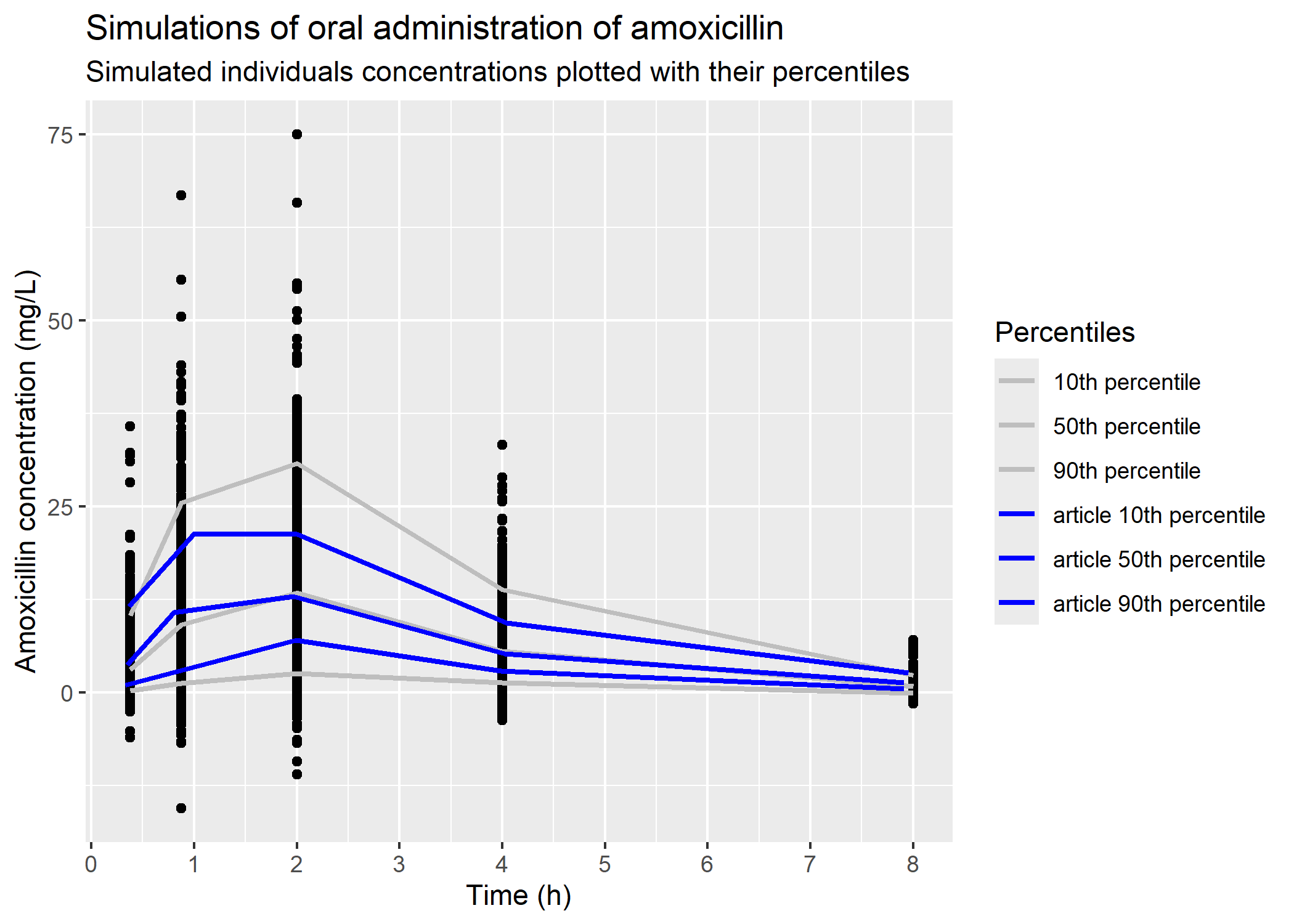
According to the article, amoxicillin plasmatic concentration measurements were done before administration and 15, 30, 45, 60, 120, 240 and 480 minutes after. Given these facts and figure 3, it looks like 5 bins were done to compute VPCs for amoxicillin oral administration : between 15 and 30 minutes, between 45 and 60 minutes, at 2, 4 and 8 hours. We tried to reproduce that binning.
We plotted 10th, 50th and 90th percentiles of our simulations with the corresponding percentiles of the siulations in figure 3. Percentiles of the simulation were retrieved from the article’s figures by digitizing the middle of the 95% confidence interval of the simulations.
Show the code
# 5 bins observées sur le graphique# rappeler temps de prélèvements indiqués dans l'article # infos sur reproduction figure # mimer le binning # mais écart normal et attendu sim_dur_8h =8model = mrgsolve::mread(model = here::here("Model_implementation_validation/mrgsolve/amox_Mellon.cpp"),show_col_types = F)five_hundreds_patients =read.csv(file = here::here("Model_implementation_validation/data/mellon_hammas_2020/patients_weights_500.csv"))five_hundreds_patientssim_step_quarter =1/4path_to_param = here::here("Model_implementation_validation/data/mellon_hammas_2020/model_parameters.csv")default =list(MIC =1, BW =1)# simulation# créer un vecteur avec les temps utilisés pour les bins # filter time in... (pour avoir simulations aux temps de prélèvement)# créer une colonne milieu de bin (bin_mid) --> case_when : si temps à 15 ou 30 : valeur 22, 5 # (médiane temps du bin, prendre la moy par convention) --> faire la moyenne # idem pour 45 et 60 min # 2, 4, et 8h prendre directement les tmepsvec_selected_times <-c(0.25, 0.50, 0.75, 1, 2, 4, 8)#sim_iv_500_patients |># dplyr::mutate(bin_mid = dplyr::case_when(time %in% c(0.25, 0.5) ~ 0.375,# time %in% c(0.75, 1) ~ 0.875))# valeur <- dplyr::case_when(sim_iv_500_patients_3$time %in% c(0,2) ~ "super")# mean 0.25 and 0.5 : 0.375# mean 0.75 and 1 : 0.875# per osdose_oral = readr::read_csv(file = here::here("Model_implementation_validation/data/mellon_hammas_2020/dosing_regimen.csv"), show_col_types = F) |> dplyr::filter(regimen_id =="oral") |> mrgsolve::as.ev()dose_oralsim_oral_500_patients =simulate_mrgsolve(dosing_regimen = dose_oral,sim_dur = sim_dur_8h,model = model,patients = five_hundreds_patients,sim_step = sim_step,param_file = path_to_param,cov_default = default,omega_mat =NULL)|> dplyr::filter(time %in% vec_selected_times) |> dplyr::select(ID, time, Y)sim_oral_500_patients# mean 0.25 and 0.5 : 0.375# mean 0.75 and 1 : 0.875first_bin_oral = sim_oral_500_patients |> dplyr::filter(time %in%c(0.25,0.50)) |> dplyr::group_by(ID) |> dplyr::summarise(mean_CP =mean(Y)) |> dplyr::mutate(time =0.375) |> dplyr::rename(Y = mean_CP)first_bin_oralsecond_bin_oral = sim_oral_500_patients |> dplyr::filter(time %in%c(0.75, 1)) |> dplyr::group_by(ID) |> dplyr::summarise(mean_CP =mean(Y)) |> dplyr::mutate(time =0.875) |> dplyr::rename(Y = mean_CP)second_bin_oralother_bins_oral = sim_oral_500_patients |> dplyr::filter(time %in%c(2, 4, 8)) |> dplyr::relocate(ID, Y)other_bins_oralsim_oral_500_patients_for_plot = dplyr::full_join(x = first_bin_oral, y = second_bin_oral) |> dplyr::full_join(y = other_bins_oral)sim_oral_500_patients_for_plot
Show the code
# oral administration# article datafig_3b_10_percentile = readr::read_csv(here::here("Model_implementation_validation/data/mellon_hammas_2020/fig_article/percentiles_simulation/fig_3_b_p10th_sim.csv"), show_col_types = F) fig_3b_50_percentile = readr::read_csv(here::here("Model_implementation_validation/data/mellon_hammas_2020/fig_article/percentiles_simulation/fig_3_b_p50th_sim.csv")) fig_3b_90_percentile = readr::read_csv(here::here("Model_implementation_validation/data/mellon_hammas_2020/fig_article/percentiles_simulation/fig_3_b_p90th_sim.csv"), show_col_types = F) # plotplot_sim_oral_500_patients_points = sim_oral_500_patients_for_plot |> dplyr::summarise(.by = time,q10 =quantile(Y, 0.10),q50 =quantile(Y, 0.5),q90 =quantile(Y, 0.90) ) |> ggplot2::ggplot() + ggplot2::geom_point(data = sim_oral_500_patients_for_plot, mapping = ggplot2::aes(x = time, y = Y)) + ggplot2::geom_line(mapping = ggplot2::aes(x = time, y = q10, color ="10th percentile"), linewidth =1) + ggplot2::geom_line(mapping = ggplot2::aes(x = time, y = q50, color ="50th percentile"), linewidth =1) + ggplot2::geom_line(mapping = ggplot2::aes(x = time, y = q90, color ="90th percentile"), linewidth =1) + ggplot2::geom_line(data = fig_3b_10_percentile, mapping = ggplot2::aes(x = time, y = CP, color ="article 10th percentile"),linewidth =1) + ggplot2::geom_line(data = fig_3b_50_percentile, mapping = ggplot2::aes(x = time, y = CP, color ="article 50th percentile"),linewidth =1) + ggplot2::geom_line(data = fig_3b_90_percentile, mapping = ggplot2::aes(x = time, y = CP, color ="article 90th percentile"),linewidth =1) + ggplot2::scale_color_manual(values =c("grey", "grey", "grey","blue", "blue", "blue")) + ggplot2::scale_x_continuous(breaks =c(0, 1, 2, 3, 4, 5, 6, 7, 8, 9)) + ggplot2::labs(title ="Simulations of oral administration of amoxicillin", subtitle ="Simulated individuals concentrations plotted with their percentiles", colour ="Percentiles",x ="Time (h)",y ="Amoxicillin concentration (mg/L)")plot_sim_oral_500_patients_points
The median of our simulations line up quite well with what was found in the paper. There is more variability in our simulation than in the paper but this could be attributed to a different distribution of patient weights in the real dataset, indeed we simulated using a uniform distribution between the minimum and maximum weights reported in the paper while it would be plausible that the real weights were more concentrated towards the center of the distribution. Also the binning will impact the closeness of our simulations with the published VPC.
Total concentrations :
Show the code
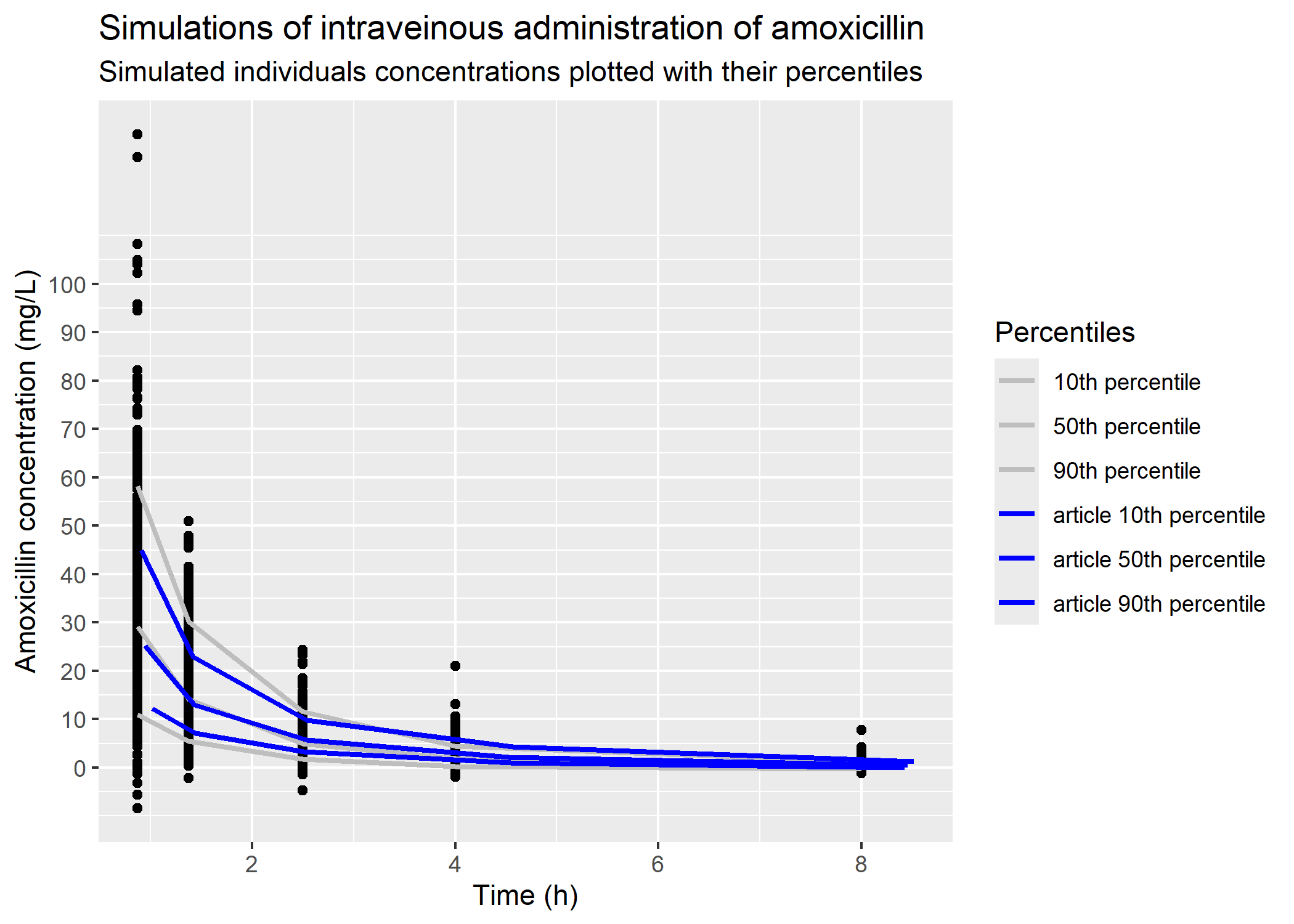
# bins may differ between IV and oral administration# It looks like there are 5 bins : between 45 minutes and 1 hour, 1 and two hour, 2 and 3 hours, 4 hours, 8 hours # dosing regimendose_iv = readr::read_csv(file = here::here("Model_implementation_validation/data/mellon_hammas_2020/dosing_regimen.csv"), show_col_types = F) |> dplyr::filter(regimen_id=="IV") |> mrgsolve::as.ev()dose_ivsim_dur_8h =8model = mrgsolve::mread(model = here::here("Model_implementation_validation/mrgsolve/amox_Mellon.cpp"),show_col_types = F)five_hundreds_patients =read.csv(file = here::here("Model_implementation_validation/data/mellon_hammas_2020/patients_weights_500.csv"))five_hundreds_patientssim_step_quarter =1/4path_to_param = here::here("Model_implementation_validation/data/mellon_hammas_2020/model_parameters.csv")default =list(MIC =1, BW =1)# in order to use omega matrices default values, omega_mat = NULL# times needed to create the binsvec_selected_times_2 <-c(0.75, 1, 1.25, 1.5, 2, 3, 4, 8)# simulationsim_iv_500_patients_2 =simulate_mrgsolve(dosing_regimen = dose_iv,sim_dur = sim_dur_8h,model = model,patients = five_hundreds_patients,sim_step = sim_step_quarter,param_file = path_to_param,cov_default = default,omega_mat =NULL) |> dplyr::filter(time %in% vec_selected_times_2) |> dplyr::select(ID, time, Y)sim_iv_500_patients_2# bins first_bin_iv = sim_iv_500_patients_2 |> dplyr::filter(time %in%c(0.75,1)) |> dplyr::group_by(ID) |> dplyr::summarise(mean_CP =mean(Y)) |> dplyr::mutate(time =0.875) |> dplyr::rename(Y = mean_CP)first_bin_ivsecond_bin_iv = sim_iv_500_patients_2 |> dplyr::filter(time %in%c(1.25, 1.5)) |> dplyr::group_by(ID) |> dplyr::summarise(mean_CP =mean(Y)) |> dplyr::mutate(time =1.375) |> dplyr::rename(Y = mean_CP)second_bin_ivthird_bin_iv = sim_iv_500_patients_2 |> dplyr::filter(time %in%c(2, 3)) |> dplyr::group_by(ID) |> dplyr::summarise(mean_CP =mean(Y)) |> dplyr::mutate(time =2.5) |> dplyr::rename(Y = mean_CP)third_bin_ivbins_4_and_5 = sim_iv_500_patients_2 |> dplyr::filter(time %in%c(4, 8)) |> dplyr::relocate(ID, Y)bins_4_and_5# data frame sim_iv_500_patients_for_plot_2 = dplyr::full_join(x = first_bin_iv, y = second_bin_iv) |> dplyr::full_join(y = third_bin_iv) |> dplyr::full_join(y = bins_4_and_5)sim_iv_500_patients_for_plot_2
Show the code
# article datafig_3a_10_percentile = readr::read_csv(here::here("Model_implementation_validation/data/mellon_hammas_2020/fig_article/percentiles_simulation/fig_3_a_p10th_sim.csv"), show_col_types = F) fig_3a_50_percentile = readr::read_csv(here::here("Model_implementation_validation/data/mellon_hammas_2020/fig_article/percentiles_simulation/fig_3_a_p50th_sim.csv"), show_col_types = F) fig_3a_90_percentile = readr::read_csv(here::here("Model_implementation_validation/data/mellon_hammas_2020/fig_article/percentiles_simulation/fig_3_a_p90th_sim.csv"), show_col_types = F) # plotplot_sim_iv_500_patients_points_2 = sim_iv_500_patients_for_plot_2 |> dplyr::summarise(.by = time,q10 =quantile(Y, 0.10),q50 =quantile(Y, 0.5),q90 =quantile(Y, 0.90) ) |> ggplot2::ggplot() + ggplot2::geom_point(data = sim_iv_500_patients_for_plot_2, mapping = ggplot2::aes(x = time, y = Y)) + ggplot2::geom_line(mapping = ggplot2::aes(x = time, y = q10, color ="10th percentile"), linewidth =1) + ggplot2::geom_line(mapping = ggplot2::aes(x = time, y = q50, color ="50th percentile"), linewidth =1) + ggplot2::geom_line(mapping = ggplot2::aes(x = time, y = q90, color ="90th percentile"), linewidth =1) + ggplot2::geom_line(data = fig_3a_10_percentile, mapping = ggplot2::aes(x = time, y = CP, color ="article 10th percentile"),linewidth =1) + ggplot2::geom_line(data = fig_3a_50_percentile, mapping = ggplot2::aes(x = time, y = CP, color ="article 50th percentile"),linewidth =1) + ggplot2::geom_line(data = fig_3a_90_percentile, mapping = ggplot2::aes(x = time, y = CP, color ="article 90th percentile"),linewidth =1) + ggplot2::scale_y_continuous(breaks =c(0, 10, 20, 30, 40, 50, 60, 70, 80, 90, 100)) + ggplot2::scale_color_manual(values =c("grey", "grey", "grey","blue", "blue", "blue")) + ggplot2::labs(title ="Simulations of intraveinous administration of amoxicillin", subtitle ="Simulated individuals concentrations plotted with their percentiles", colour ="Percentiles",x ="Time (h)",y ="Amoxicillin concentration (mg/L)") plot_sim_iv_500_patients_points_2
Overall our simulations line up quite well with what was found in the paper. Slight differences were expected due to binning.
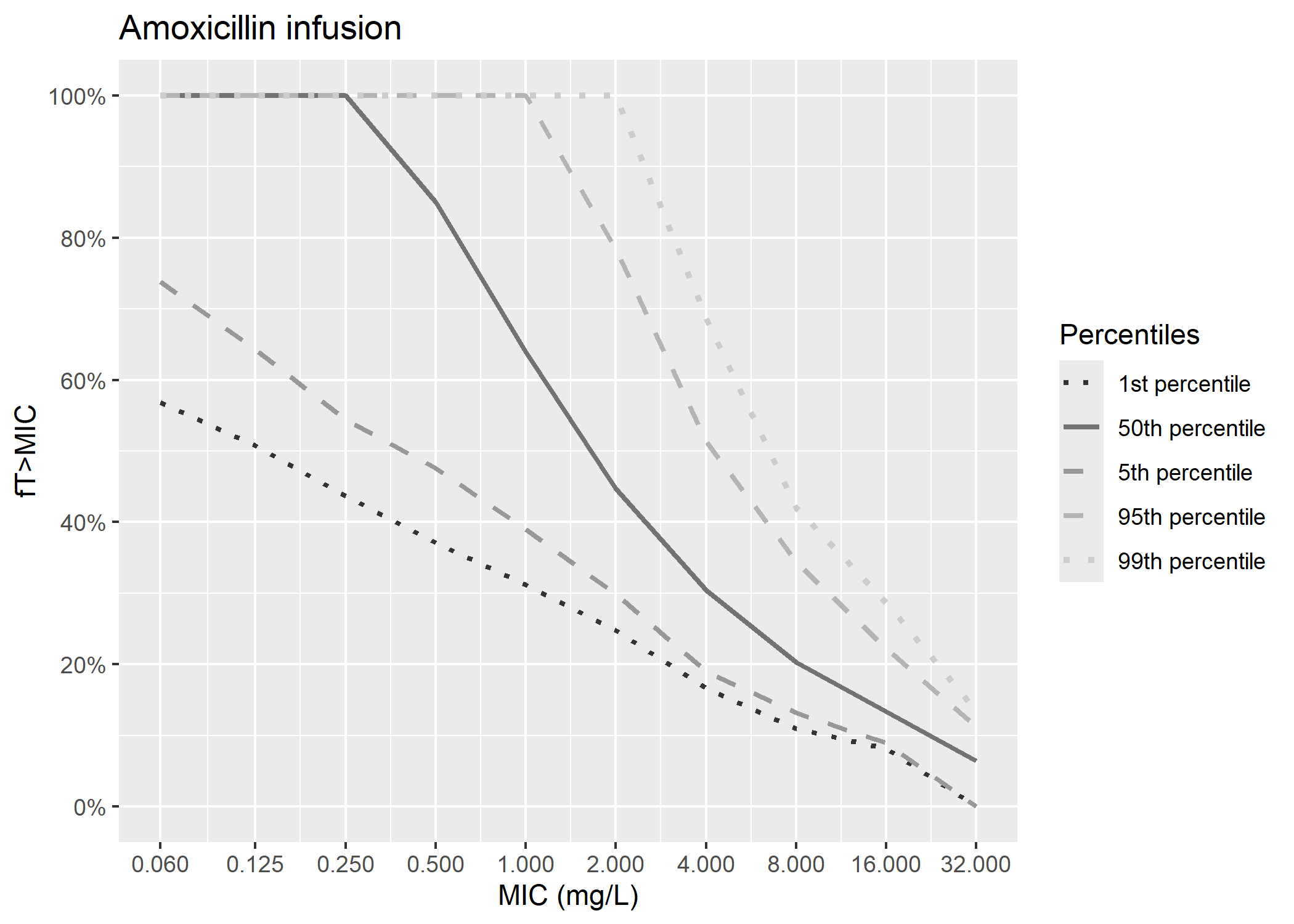
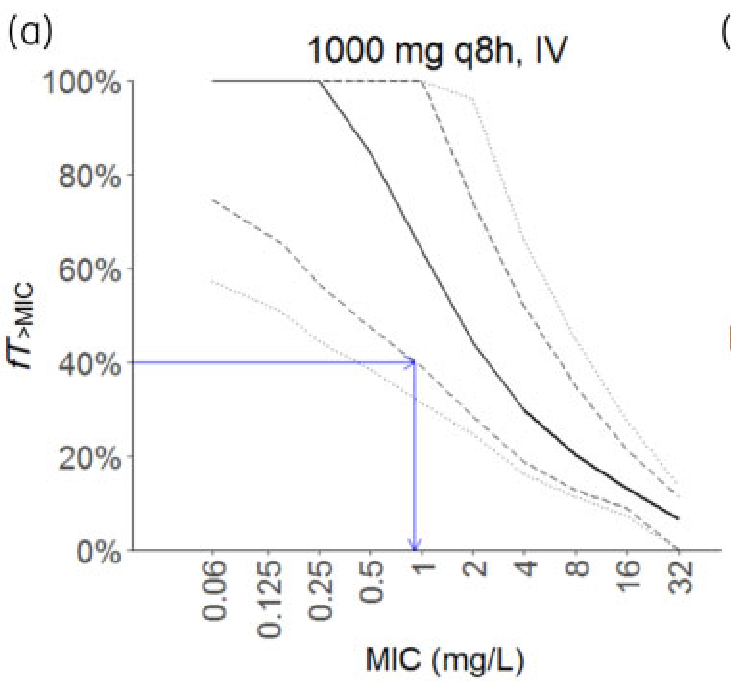
9 Figure 4
Show the code
# generate weights from the uniform distribution : set.seed(100)weights_1000 =runif(n =1000, min =85, max =155) |>as.data.frame() |> dplyr::rename(BW ="runif(n = 1000, min = 85, max = 155)") |> dplyr::mutate(ID =1:1000)write.csv(weights_1000, file = here::here("Model_implementation_validation/data/mellon_hammas_2020/patients_weights_1000.csv"), row.names =FALSE)
Mellon, G, K Hammas, C Burdet, X Duval, C Carette, N El-Helali, L Massias, F Mentré, S Czernichow, and A -C Crémieux. 2020. “Population Pharmacokinetics and Dosing Simulations of Amoxicillin in Obese Adults Receiving Co-Amoxiclav.”Journal of Antimicrobial Chemotherapy 75 (12): 3611–18. https://doi.org/10.1093/jac/dkaa368.